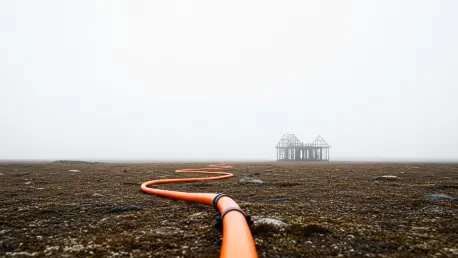

A bright orange pipe emerges from the subarctic soil of Adak Island, carrying state-of-the-art fiber-optic cable into a house with no windows, no furniture, and grass growing through the floorboards. This is not a forgotten relic of a bygone era or a peculiar art installation, but rather the active recipient of massive federal subsidies paid for by the American taxpayer. While the world’s most remote former Navy base crumbles into the frigid Bering Sea, the government continues to foot a multimillion-dollar bill to provide high-speed internet to collapsed roofs, empty subdivisions, and rusted debris. In a place where the local McDonald’s has been shuttered for decades and the wind howls through hollowed-out barracks, the federal government maintains a “digital bridge” to nowhere, funding a sophisticated network that almost no one on the island actually uses.
This situation highlights a profound systemic failure within the United States government’s efforts to bridge the digital divide. At the heart of this investigation is the Federal Communications Commission’s Universal Service Fund, a multibillion-dollar initiative intended to bring modern communication to the nation’s most isolated regions. However, the disconnect between Washington policy and the reality of Adak Island reveals a loophole where subsidies are tied to the existence of physical locations rather than actual human subscribers. As millions of dollars flow into the pockets of providers for wiring ghost homes, the program risks becoming a permanent support payment for obsolete infrastructure and corporate mismanagement rather than a tool for public progress.
Fiber-Optic Cables in the Tall Grass of the Aleutians
The landscape of Adak Island serves as a haunting testament to military history and modern administrative inertia. Once a bustling outpost housing thousands of sailors and their families during the Cold War, the base was officially closed toward the end of the last century, leaving behind a sprawling skeleton of suburban Americana at the edge of the world. Today, the island is a post-apocalyptic scene where rows of identical houses slowly succumb to the relentless Aleutian elements. Despite this decay, the Federal Communications Commission continues to categorize these ruins as viable service locations, prompting the installation of high-tech infrastructure in places where the only residents are nesting birds and the occasional wandering fox.
Walking through the abandoned subdivisions, one might notice the stark contrast between the rotting plywood of the homes and the pristine orange conduits carrying high-speed fiber-optic lines. These cables represent the pinnacle of modern connectivity, yet they terminate in living rooms where the floorboards have long since rotted away. The federal government’s insistence on funding these connections ignores the physical reality that many of these structures are completely uninhabitable. It creates a surreal environment where taxpayer-funded technology is deployed to serve buildings that lack basic utilities like heat, water, or even doors, effectively treating a graveyard of architecture as a thriving modern community.
The maintenance of this “ghost network” serves as a striking example of how federal initiatives can lose sight of their original purpose. Instead of adapting to the shrinking population of the island, which now consists of roughly two dozen hardy souls, the funding mechanisms remain anchored to the peak population figures of the military era. This results in a scenario where the cost of connectivity per actual resident reaches astronomical levels, far exceeding any reasonable definition of public utility. While the intentions behind rural broadband are noble, the application in Adak illustrates a failure to perform basic ground-level verification of where the money is actually going.
The High Cost of Bridging the Digital Divide
The financial engine driving this project is the Universal Service Fund, a massive pool of capital generated by mandatory fees on nearly every American’s monthly phone bill. This fund was established with the egalitarian goal of ensuring that geographic isolation does not result in digital isolation for residents of rural America. In theory, the subsidies offset the extreme costs associated with laying cable across rugged tundra or shipping equipment to remote islands. However, the Adak Eagle project reveals how these funds can be diverted into maintaining infrastructure for buildings that no longer house human life. When subsidies are calculated based on the potential to serve a “location” rather than the reality of serving a “person,” the incentive for efficiency disappears.
This systemic flaw is exacerbated by the lack of direct oversight regarding the habitability of subsidized addresses. Under current federal regulations, telecommunications companies are rewarded for the mere availability of service, meaning they can continue to draw funds as long as they can prove a line reaches a structure. The FCC’s bureaucratic reliance on maps and data points provided by the companies themselves often omits the crucial detail that the “house” on the map is actually a pile of rubble. This creates a perverse incentive for providers to maintain connections to ruins rather than focusing on improving service for the few actual residents who remain on the island.
The economic disparity of this model is staggering when compared to the service levels provided. For the millions of dollars injected into the Adak network, the resulting service is frequently described as sluggish and overpriced. This suggests that the Universal Service Fund is not functioning as a bridge to the future, but rather as a life-support system for a legacy business model that is no longer viable in the face of modern technology. Without a requirement that funds follow the user, the program remains a wealth transfer from the general public to regional monopolies that have little reason to innovate or downsize their operations to match the actual needs of the community.
The Anatomy of a Subsidy Scandal on Adak Island
Since 2016, the telecommunications provider on Adak has collected over $10 million from various federal and state programs, a figure that is difficult to justify given the island’s skeletal population. These funds were intended to ensure that the small community could participate in the modern economy through affordable and reliable broadband. Yet, investigations have shown that the subsidized landline service is so ineffective that it has been almost entirely abandoned by the people it was meant to help. Residents reported that the speeds offered by the local provider were barely enough to check email, despite the massive influx of government cash meant to upgrade the system to 21st-century standards.
The disruption of this subsidized monopoly arrived in the form of private satellite technology, which has fundamentally changed the connectivity landscape of the Aleutians. Without receiving any government subsidies, companies like Starlink have provided the residents of Adak with speeds nearly 50 times faster than the taxpayer-funded landlines at a fraction of the cost. The residents have collectively voted with their wallets, migrating to satellite service for their streaming, gaming, and communication needs. Even the employees tasked with maintaining the subsidized fiber-optic network have been found using private satellite dishes at their own homes, a clear indication that the government-funded “bridge” is effectively obsolete.
Furthermore, the “availability” loophole allows for the continued collection of funds for locations that are demonstrably useless. The telecommunications provider can claim it is serving hundreds of buildings, even if those buildings have been slated for demolition or have collapsed under the weight of winter snow. This accounting trick allows for the persistence of high-dollar payouts based on a demographic reality that hasn’t existed for decades. The result is a cycle of waste where the federal government pays for the upkeep of a network that connects to empty rooms, while the actual population relies on an entirely different, unsubsidized technology to stay connected to the world.
Institutional Inertia and the Shield of National Security
The persistence of these payments, despite clear evidence of waste and a dwindling subscriber base, points to a troubling lack of accountability and the use of convenient geopolitical narratives. The leadership of the Adak Eagle project has faced federal scrutiny in the past for allegedly using subsidy funds for non-telecommunications expenses, including the purchase of personal vehicles and a fishing boat. Despite these red flags and a documented history of regulatory friction, the flow of taxpayer money has not been halted. This suggests that the oversight mechanisms within the FCC are either too slow to react or are being bypassed by broader political considerations that prioritize presence over performance.
Policymakers and regional advocates often invoke the “strategic outpost” argument to justify the continued funding of Adak’s infrastructure. Given the island’s location near Russian and Chinese naval lanes, there is a lingering sentiment that the United States must maintain a foothold on the island for national security reasons. Senator Dan Sullivan and other officials have suggested that keeping the island wired is a matter of long-term defense readiness. However, this argument often serves as a shield against legitimate questions about financial mismanagement. While the military may have a future interest in Adak, the current subsidies are specifically designated for civilian broadband service, not defense infrastructure, and the two should not be conflated to avoid audits.
Institutional inertia also plays a significant role in the ongoing funding of the ghost town. Once a subsidy program is established, it becomes a predictable revenue stream for the provider and a checkbox for the regulator. The bureaucratic effort required to re-map a remote island and decertify hundreds of “ghost locations” is significant, and there is often little political will to challenge the status quo in rural districts. This leads to a situation where the government continues to fund the past because it is easier than acknowledging that the current model has failed. The shield of national security provides a convenient excuse for the FCC to ignore the fact that it is subsidizing fiber-optic lines to piles of wet wood and rusted metal.
Strategies for Modernizing Federal Broadband Oversight
The investigation into the connectivity of Adak Island provided a necessary wake-up call for how federal broadband funds were distributed across the country. It was demonstrated that a transition from a legacy hardware mindset toward a performance-based model was the only way to prevent the Universal Service Fund from being drained by ghost infrastructure. Policymakers noted that implementing a subscriber-based funding model would have ensured that taxpayer dollars followed the actual human user rather than the physical wire. By rewarding companies for verified active connections, the government could have avoided the trap of paying for service to uninhabitable ruins and abandoned barracks.
Technological neutrality became a cornerstone of proposed reforms as the gap between subsidized landlines and private satellite service widened. It was observed that continuing to fund expensive terrestrial builds in areas where satellite technology provided superior service was no longer a defensible use of public funds. Integrating satellite solutions into the subsidy framework allowed the government to reach remote populations more efficiently while saving millions that were previously wasted on redundant or failing land-based networks. This shift recognized that the goal was connectivity itself, not the preservation of any specific company’s aging hardware.
Mandatory physical audits and strict clawback provisions were also highlighted as essential tools for future oversight. The Adak case showed that the government could not rely on self-reporting from providers who had a financial interest in exaggerating the number of served locations. Requiring door-to-door verification of subsidized infrastructure ensured that every dollar spent was tied to a habitable structure and a functioning service. By establishing harsh penalties for the misuse of funds, the federal government took steps to transform the Universal Service Fund from a corporate safety net into a lean, accountable system that truly served the remaining pioneers of the American frontier.