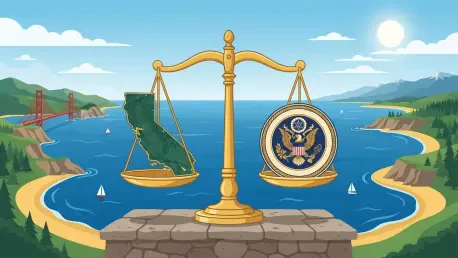

State officials have until November 16, 2026, to respond to federal demands that could fundamentally dismantle a fifty-year-old cooperative framework for coastal preservation. This looming deadline stems from a draft report by the National Oceanic and Atmospheric Administration, which suggests a radical departure from the historic partnership between Washington and Sacramento. The document alleges that California state agencies have engaged in systemic jurisdictional overreach, effectively weaponizing environmental regulations to stall or block projects that align with national priorities. By framing the state’s actions as politically motivated rather than purely ecological, the federal government is laying the groundwork for a massive reassessment of how the nation’s coastlines are managed. This friction is not merely a bureaucratic spat but a fundamental clash over whether a state can maintain its own environmental standards when they collide with federal industrial and defense goals along the Pacific.
The Legal Framework: Coastal Management Under Scrutiny
The Coastal Zone Management Act of 1972 serves as the primary legal mechanism governing this delicate balance of power. Under this federal law, California was granted the authority to perform consistency reviews, a process that ensures federal projects or those receiving federal permits remain in harmony with the state’s own coastal management program. For decades, this framework functioned as a model of cooperative federalism, allowing local experts and state officials to apply specific environmental safeguards to large-scale developments. However, the current administration argues that California has strayed far from the original intent of the law, using these reviews to exert control over areas that should fall under federal jurisdiction. This shift in interpretation threatens to transform the act from a tool of coordination into a source of constant litigation, as the federal government now views state-level oversight as a hurdle to be cleared rather than a partner to be consulted.
The draft report from federal regulators marks a significant escalation by formally accusing California’s coastal agencies of harboring industrial hostility and political bias. Federal investigators have identified a pattern where state officials allegedly utilize environmental permitting to target specific sectors, most notably oil production and private aerospace enterprises. This perceived bias has prompted the federal government to threaten the revocation of California’s oversight authority entirely, a move that would decertify the state’s coastal program and strip it of its legal standing to challenge federal actions. Such a drastic measure would not only defund essential state programs but also create a regulatory vacuum where national industrial interests supersede local ecological protections. The federal position maintains that state regulations must remain neutral and focused on objective environmental impact rather than serving as a platform for challenging broader national energy or defense strategies.
Strategic Implications: State Sovereignty and Legal Action
Nowhere is this tension more evident than in the burgeoning aerospace and energy sectors within the Tri-Counties region. The expansion of SpaceX launches at Vandenberg Space Force Base became a flashpoint when federal officials accused the California Coastal Commission of letting personal political grievances against leadership interfere with the permitting process. While the commission initially sought more rigorous environmental assessments, the federal government characterized these demands as an attempt to stymie national security interests under the guise of ecological protection. Similarly, the long-dormant oil pipeline along the Gaviota Coast has become a symbol of this jurisdictional divide. After a major rupture, the state has resisted efforts by Sable Offshore Corporation to resume operations. In response, federal authorities have considered invoking mid-century laws and eminent domain to ensure energy production continues, regardless of state-level environmental concerns or historical precedents.
The confrontation reached a critical point where compromise appeared unlikely without significant federal concessions on local environmental autonomy. To safeguard its jurisdiction, California was required to leverage its established legal precedents to demonstrate that its consistency reviews remained based on rigorous scientific data rather than political bias. State agencies focused on documenting the specific ecological impacts of industrial projects to provide a robust record for the inevitable court challenges. As the federal government moved to strip oversight powers, the resulting litigation served as a landmark case for the United States Supreme Court regarding the boundaries of state and federal power. This legal strategy required immediate coordination between the Attorney General’s office and coastal regulators to ensure that the state’s environmental legacy was not dismantled by executive fiat. These actions provided a clear roadmap for other states facing similar federal pressure.