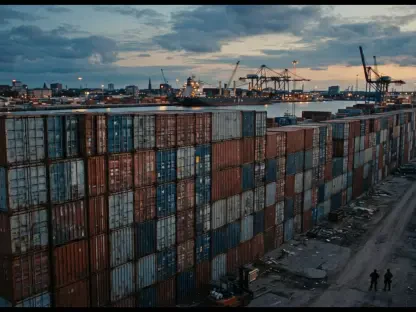

The silence stretching across the turquoise waters of the Persian Gulf today speaks much louder than the usual thunder of diesel engines and the churning wakes of thousand-foot tankers. For decades, the Strait of Hormuz has served as the central artery of the global energy market, with an average of 130 massive vessels pulsing through its waters every day. Today, that pulse has effectively flatlined, as the once-bustling “Southern Highway” stands eerily quiet under the relentless sun.
This sudden silence in one of the world’s busiest maritime passages signals a profound shift in global commerce, as shipping giants trade transparency for survival in an increasingly hostile environment. Recent intelligence reveals that not a single large vessel exceeding 10,000 deadweight tonnage has broadcasted its location while using this US-coordinated route since early July. The void left by these missing vessels suggests that the traditional rules of the sea are being rewritten by necessity, as the risk of being a visible target outweighs the operational benefits of open broadcasting.
The Vanishing Traffic of the World’s Most Vital Energy Corridor
The disappearance of large-scale maritime traffic represents a jarring departure from historical norms. Previously, the Strait was a theater of constant movement, a logistical marvel where hundreds of millions of dollars in cargo transitioned every hour. Now, the waters have become a dead zone for the automated identification systems that once provided a clear picture of global energy flows. This absence of data is not merely a technical glitch but a deliberate tactical choice by ship owners who no longer believe the “Southern Highway” can offer the protection it once promised.
When the 10,000 deadweight tonnage threshold is crossed, the vessels involved are typically massive crude carriers or large container ships that are critical to international supply chains. Their sudden decision to stop broadcasting locations indicates a deep-seated lack of confidence in current maritime security protocols. This shift toward total opacity has turned a once-transparent market into a speculative guessing game, forcing analysts to rely on satellite imagery and guesswork to track the lifeblood of the global economy.
Geopolitical Tit-for-Tat and the Erosion of Maritime Security
The current instability is the direct result of a volatile cycle of retaliation between the United States and Iran, which has expanded far beyond localized skirmishes. Following strategic US strikes on dozens of Iranian targets, Tehran responded by striking military assets across a broad swathe of the Middle East, including Bahrain, Kuwait, Qatar, Jordan, and Iraq. This escalating friction transformed the Strait from a predictable transit point into a high-risk combat zone where merchant ships are caught in the crossfire of national interests.
For the global economy, the stakes are exceptionally high because the persistence of this instability threatens to make trade route shifts permanent. If the risk remains elevated, established regional ports and infrastructure could face obsolescence as shipping companies seek more stable, albeit longer, alternatives. This erosion of maritime security is not merely a temporary hurdle but a fundamental challenge to the logistical architecture that has supported global trade for decades.
The Mechanics of a “Dark” Crossing and Energy Market Realities
As traditional shipping lanes become untenable, the maritime industry is shifting toward a cautious posture that involves disabling tracking systems to facilitate “dark” crossings. While this tactic mitigates immediate military threats by making vessels harder to track, it introduces significant complexity to global logistics. Disabling the Automatic Identification System (AIS) creates a “blind” environment, increasing the physical risk of collisions and complicating the bureaucratic processes of insurance and port arrival coordination.
Simultaneously, the energy sector is bracing for a supply squeeze that could ripple through every corner of the market. Although Brent crude has remained steady at approximately $76 per barrel, a looming $10 to $15 price hike is projected as global inventories are depleted. This pressure is most acute in the refined petroleum market, where the combination of Middle Eastern disruptions and ongoing attacks on Russian refineries is driving diesel prices toward a breaking point, threatening to reignite inflationary pressures.
Market Decoupling and the Warnings of Commodity Strategists
In a surprising turn, global equity markets in the United States and Asia have continued an upward trend despite the regional chaos. This suggests a rare decoupling of investor sentiment from geopolitical volatility, where traders seem to be betting on localized containment rather than global contagion. However, seasoned commodity strategists warn that this optimism is likely premature and detached from the physical realities of supply and demand that govern the underlying economy.
Data from Lloyd’s List Intelligence and Windward indicate that the physical reality of dwindling oil products will eventually collide with financial markets. Experts suggest that as supply chain stress intensifies, the cost of the conflict will inevitably be passed down to the consumer, regardless of how well stock indices perform in the short term. The gap between paper wealth and physical scarcity is narrowing, and the correction could be sharp once the inventory cushions are gone.
Strategies for Managing Supply Chain Disruptions in Volatile Zones
Stakeholders who successfully navigated this shifting landscape adopted a multi-tiered framework for resilience that moved beyond traditional risk assessment. They diversified transit routes to bypass regional chokepoints and increased buffer stocks of critical refined products like diesel to hedge against price spikes. Logistics firms implemented enhanced real-time monitoring of dark transit trends and geopolitical triggers to anticipate shifts in lane availability before they became crises.
By prioritizing agility and inventory depth, these businesses mitigated the impact of a conflict that was rewriting the rules of global maritime trade. This approach shifted the focus from just-in-time delivery to a more robust “just-in-case” philosophy, ensuring that vital goods continued to flow despite the silence in the Strait. The industry ultimately learned that in a world of kinetic geopolitics, the ability to adapt was more valuable than the efficiency of established routes.