
Donald Gainsborough stands at the intersection of high-stakes diplomacy and global energy security, serving as a leading voice in policy legislation through his work at Government Curated. With years of experience navigating the volatile relationship between geopolitical conflict and market stability, Gainsborough offers a seasoned perspective on the current crisis unfolding in the Middle East. Our discussion explores the recent military strikes in the Strait of Hormuz, the dramatic reduction in maritime traffic through one of the world’s most vital corridors, and the specific economic ripples felt across Asian stock markets. We also delve into the shifting strategies of global refiners as they attempt to decouple from a region increasingly defined by “unwarranted aggression” and fragile diplomatic memorandums.
Brent crude recently climbed over 4 percent to nearly $79 per barrel. How does this spike reflect the immediate military reality on the ground in the Strait of Hormuz?
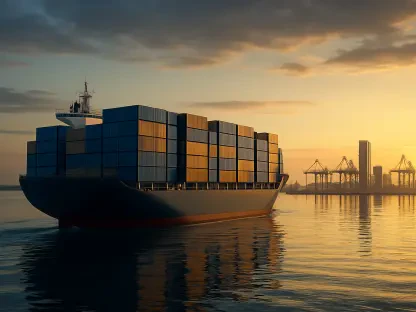
The jump to $78.82 per barrel is a visceral reaction to the smell of gunpowder and the sight of rising smoke over a waterway that handles one-fifth of the global oil trade. When the US Central Command announced it had struck dozens of Iranian targets to degrade their offensive capabilities, the markets immediately priced in the risk of a full-scale blockade. We are seeing a 9 percent increase in prices compared to the initial strikes back in February, which tells us that traders no longer believe in a quick de-escalation. The “blatant” attack on the MV GFS Galaxy, a Cyprus-flagged container ship, acted as a catalyst, proving that commercial shipping is now directly in the crosshairs of this standoff. It is a tense environment where every missile launch translates into immediate financial pressure for the rest of the world.
With the US launching waves of strikes to protect freedom of navigation, what does this tell us about the current state of control over this critical maritime corridor?
The situation is a direct challenge to the international order, as CENTCOM has explicitly stated that Iran does not control the Strait of Hormuz, despite their aggressive claims. By striking hundreds of targets, the US is attempting to physically strip away Iran’s ability to harass vessels, yet the defiance from Tehran remains palpable. Iranian forces responded with a terrifying wave of missile and drone attacks stretching across the UAE, Qatar, Kuwait, Oman, and Bahrain, showing that the conflict is no longer contained to a single stretch of water. This is a high-stakes game of chicken where the US is “postured and prepared” to defend the corridor, while Iran uses its Persian Gulf Strait Authority to issue chilling warnings that any ship on an unauthorized route will lose its safe passage guarantees. The friction is constant, and the legal battle over who dictates the “preferred route” has turned into a kinetic military struggle.
The data shows a staggering drop in the number of ships actually passing through the strait. What are the long-term implications of seeing traffic fall from 130 vessels a day to just a handful?
The silence on the water is perhaps the most alarming metric we have, as we saw the daily average of 130 vessels during peacetime collapse to just six ships during certain windows last week. Between Thursday and Friday, the intelligence platform Windward tracked a mere fraction of the usual traffic, highlighting a collective “breath-holding” by the global shipping industry. Even when traffic ticked up slightly to nine vessels over the weekend, nearly half of those were flying the Iranian flag, suggesting that international carriers are simply too terrified to enter the fray. This sharp decline reflects a total breakdown of the memorandum of understanding that briefly stabilized the region in June. When the heartbeat of global energy slows down to this degree, it forces a massive, costly rerouting of the entire world’s supply chain.
Analysts suggest that while prices are up, they might not hit the extreme peaks seen earlier in the conflict. What factors are keeping a lid on a total price explosion?
There is a fascinating tug-of-war happening between the “risk premium” of the war and the cold reality of global oversupply. While the re-escalation exposes how fragile the US-Iran arrangement truly was, we are also seeing OPEC+ output quota expansions and the release of barrels from previously stranded tankers adding volume to the market. Furthermore, global demand is proving slow to recover, which acts as a natural dampener on how high these spikes can go. Even as we deal with “unwarranted aggression” in the Middle East, the market is currently more insulated than it was a year ago. It is a delicate balance where the fear of a closed strait is being countered by a world that is currently awash in more oil than it strictly needs.
How is this maritime instability changing the way refiners and large-scale oil purchasers plan for the future?
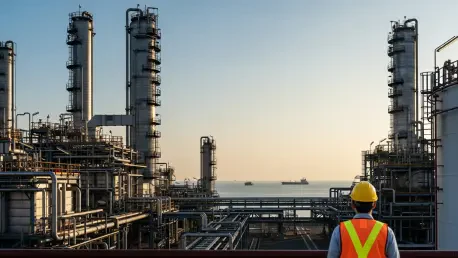
The current chaos is reinforcing a trend of “long-haul procurement,” where refiners are forced to make their supply decisions many weeks or even months in advance to avoid being caught in a sudden blockade. We are seeing a deliberate and strategic reduction in the immediate reliance on Middle Eastern crude as a direct response to this heightened geopolitical uncertainty. Expert analysis suggests that Brent will likely stay in the upper $70s through August and September, which provides a predictable, if elevated, price floor for these buyers. The latest wave of attacks is likely to cement this shift away from the Gulf, as refiners value the peace of mind of a secure supply line over the proximity of the Strait. This isn’t just a temporary pivot; it is a structural change in how the world’s energy is sourced.
The financial impact seems to be hitting Asian markets particularly hard. Why did we see such a dramatic plunge in indices like the Kospi?
The 9 percent plunge in South Korea’s Kospi is a clear indicator of how vulnerable energy-dependent Asian economies are to any disruption in the Strait of Hormuz. Similarly, Japan’s Nikkei 225 falling nearly 2 percent shows that investors are fleeing to safety as the prospect of sustained fighting threatens the industrial heart of the East. These markets react with such volatility because they operate on thin margins that can be obliterated by a sudden rise in shipping insurance and fuel costs. While Hong Kong’s Hang Seng managed a tiny 0.2 percent gain, the general mood across the region is one of deep anxiety. When the primary artery for your nation’s energy is being contested by drones and missiles, the stock market is the first place that fear manifests.
What is your forecast for the stability of global oil prices if the standoff in the Strait of Hormuz continues through the end of the year?
I expect we will see a period of “volatile stagnation,” where Brent crude maintains its position in the upper $70s but remains prone to sudden, violent spikes whenever a new vessel is targeted. The fundamental reality is that as long as Iran claims the right to revoke “safe passage guarantees” and the US continues its “degrading” strikes, the risk premium will not evaporate. However, because refiners have already begun diversifying their supply chains and demand remains lukewarm, we likely won’t see a return to the triple-digit prices that many feared at the start of the war. The “best-case outcome” that markets priced in back in June has been shattered, but the global energy infrastructure has proven surprisingly resilient. We are entering a new normal where the Strait of Hormuz is treated as a permanent combat zone rather than a reliable trade route.