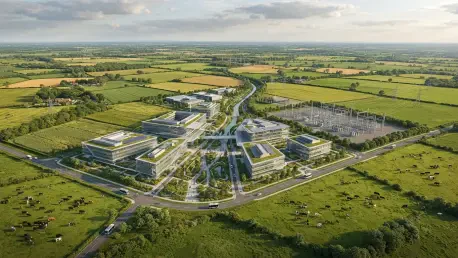

The rhythmic thumping of industrial pile drivers has replaced the seasonal cadence of harvest machinery in the black soil of Williamson County, signaling a permanent departure from the region’s agrarian heritage. This transition represents more than a local zoning change; it is a fundamental reconfiguration of the American rural landscape as global technology giants seek the isolation, space, and power availability found in former agricultural sanctuaries. As urban tech hubs become saturated with high costs and limited space, the expansion into “greenfield” sites has accelerated, turning quiet farming communities like Taylor, Texas, into critical nodes of the global digital economy. The implications of this shift are profound, touching upon everything from the stability of the state’s electrical grid to the preservation of multi-generational land trusts that were once considered untouchable.
The Shift from Pastoral Landscapes to Digital Powerhouses
The migration of semiconductor plants and hyperscale data centers into rural Texas is no longer a speculative trend but a tangible industrial overhaul that is redefining the state’s economic geography. For decades, the outskirts of Austin were characterized by vast cotton fields and cattle ranches, providing a buffer between urban sprawl and the rural interior. However, the current period from 2026 to 2028 is witnessing an unprecedented influx of high-density technology infrastructure into these zones. The primary driver behind this movement is the insatiable demand for land that can support massive physical footprints, a requirement that traditional urban environments can no longer meet without exorbitant costs and regulatory hurdles.
Statistical Growth of Rural Industrial Clusters
Current data indicates that the industrial footprint in rural Texas has expanded at a rate that outpaces nearly every other sector, with nearly 600 data center facilities now either operational or in advanced stages of planning across the state. This “Texas Data Center Boom” is characterized by a significant move toward regions that were previously ignored by the high-tech sector. In Taylor, for instance, the combined energy requirement for newly approved industrial projects has reached a staggering 1.42 gigawatts. This volume of power consumption is roughly equivalent to the entire annual electricity usage of the city of Austin, illustrating the sheer magnitude of the technology being integrated into these small-town environments.
The growth is not limited to energy consumption but extends to the physical scale of the facilities themselves, which often span hundreds of acres. Reports from economic analysts suggest that the concentration of such infrastructure in rural zones is a strategic response to the needs of artificial intelligence processing and cloud storage. These facilities require vast cooling systems and high-voltage electrical substations that are often incompatible with the aesthetic and logistical constraints of suburban residential areas. Consequently, the trend toward rural industrialization has become a default solution for “Big Tech” as it seeks to maintain the rapid pace of digital infrastructure expansion without the limitations of urban density.
Real-World Applications and Industrial Catalysts
The primary catalyst for this local transformation was the establishment of the Samsung Electronics semiconductor facility, a project that serves as a benchmark for foreign direct investment in rural Texas. Spanning a 1,200-acre campus, this facility represents a massive commitment to domestic chip production, bringing with it a complex supply chain that further industrializes the surrounding area. The presence of such a monumental manufacturing hub has created a magnetic effect, drawing in auxiliary industries and high-capacity data centers that seek to leverage the upgraded infrastructure and proximity to the semiconductor giant. This secondary wave of development is what has truly altered the character of the region, moving it beyond a single-site project into a full-scale industrial corridor.
Specific examples of this rapid infrastructure growth include the Blueprint Projects and the KDC Project Comal, both of which are designed to serve the escalating needs of AI processing. These hyperscale campuses are not mere warehouses; they are sophisticated industrial engines that require constant maintenance and significant environmental resources. Furthermore, the annexation of agricultural land for projects like the Taylor Technology Campus, formerly known as “Project Mustang,” highlights the trend of high-density technology campuses replacing traditional farming operations. This 664-acre project, which began active development in late 2025 and is expected to continue through 2027, demonstrates how quickly large tracts of “sanctuary” land can be reclassified for industrial use.
Perspectives from Stakeholders and Industry Experts
The rapid industrialization of Taylor has created a deep divide among stakeholders, with each group viewing the progress through a vastly different lens. Economic development corporations and local government officials often champion these projects as the ultimate solution for community prosperity, pointing toward the influx of tax revenue and the creation of specialized jobs. From their perspective, the transition is a necessary evolution that ensures the long-term financial viability of the region, allowing for the funding of schools, roads, and public services that a purely agricultural tax base could never sustain. They argue that without such significant investments, small towns risk stagnation and decline in an increasingly competitive global economy.
In contrast, legal experts and state officials have expressed growing concerns regarding the mechanisms used to secure land for these industrial projects. The Texas Attorney General has specifically scrutinized land-use “trusts” and the removal of deed restrictions that were originally intended to preserve land for public or agricultural use. The controversy surrounding the “Bland land”—an 87-acre tract originally designated for parkland—serves as a cautionary tale about the flexibility of zoning when faced with multi-million dollar industrial offers. Legal professionals suggest that the erosion of these protections could set a dangerous precedent, where the historical intent of a land grant is easily bypassed by the immediate economic demands of the technological sector.
Grassroots leaders and local residents represent the third and most vocal perspective, focusing on the preservation of what they describe as “rural identity.” For many families who moved to the area to escape the noise and congestion of the city, the arrival of massive cooling fans and 24-hour construction is viewed as an infringement on their quality of life. These residents often feel disenfranchised by a process they perceive as prioritizing corporate interests over the well-being of the established community. The tension between industrial progress and the desire for a quiet, predictable lifestyle has led to organized resistance, highlighting the social friction that occurs when global economic forces collide with local heritage and residential expectations.
Future Implications and the Path Forward
The long-term consequences of placing massive industrial complexes in the heart of rural communities are only beginning to manifest, with environmental factors at the forefront of the discussion. The “heat island” effect, once thought to be a strictly urban phenomenon, is now a concern for former green spaces that have been covered in concrete and server racks. The heat generated by thousands of processing units, combined with the loss of natural vegetation, can alter local microclimates, potentially affecting nearby agricultural yields and increasing cooling costs for neighboring residents. Moreover, the strain on local water resources for cooling these facilities remains a significant hurdle, especially in regions prone to seasonal droughts and water scarcity.
The potential for new regulatory frameworks is emerging as a critical necessity to address the imbalance between industrial power and resident rights. Specific digital infrastructure zoning is being discussed as a way to mitigate disenfranchisement, ensuring that data centers and manufacturing plants are confined to areas where their noise and environmental footprint will have the least impact on human health and livestock. Such frameworks could mandate stricter noise-dampening technologies and more transparent land-acquisition processes, potentially requiring developers to contribute more directly to environmental mitigation funds. Without these regulations, the encroachment of “Big Tech” into residential sanctuaries could lead to a permanent “decline in rural appeal,” driving out the very demographic that seeks the solace of the countryside.
Broadly speaking, the trend in Taylor is a microcosm of a global struggle to balance the physical requirements of a digital civilization with the human need for quietude and environmental stability. As more agricultural and residential sanctuaries are annexed for high-density tech use, the definition of “rural” is being fundamentally rewritten. This shift suggests a future where the countryside is no longer a place of escape, but rather a functional extension of the industrial machine. The outcome of the conflicts in Texas will likely influence how other regions across the globe manage the arrival of massive technology campuses, determining whether industrial progress and community preservation can coexist or if one must inevitably consume the other.
Summary of the Rural Tech Transformation
The transformation of Taylor, Texas, provided a clear window into the intricate tensions that arose when economic modernization confronted historic rural heritage. It became evident that the transition from a railroad-centric farming community to a semiconductor and data processing hub was not a seamless evolution, but rather a disruptive process that forced a reevaluation of what it meant to be a rural resident. The case of Taylor stood as a definitive precedent, illustrating that the promise of tax revenue and high-tech infrastructure often came at the cost of the quiet and environmental stability that defined the region for over a century. Through this lens, the industrial-rural conflict was seen as a primary challenge for local governance, requiring a level of transparency and community engagement that was often missing in the early stages of development.
The legal and social battles over land use and noise pollution demonstrated that the path toward sustainable development required more than just financial investment; it demanded a commitment to the social fabric of the community. In the end, the success of these massive industrial projects was judged not only by their technological output but also by their ability to coexist with the people who called the surrounding land home. The investigation into land trusts and the formation of grassroots coalitions proved that residents were unwilling to let their history be erased by the march of progress without a fight. This period of rapid change showed that for technology growth to be truly beneficial, it had to be balanced with the preservation of the community’s health and the ecological integrity of the land.
Ultimately, the strategies developed in Taylor offered a blueprint for future governance in an era of global tech encroachment. It was determined that proactive zoning and clear environmental standards were essential tools for preventing the disenfranchisement of local populations. The lessons learned during this industrial pivot highlighted the necessity of treating rural land not merely as an empty space for expansion, but as a living environment with deep-seated cultural and biological value. By the conclusion of the most intense development phases, it was clear that the future of rural industrialization depended on a collaborative approach that honored the past while preparing for the digital requirements of the current age. The dialogue between the silicon giants and the local farmers eventually paved the way for a more nuanced understanding of progress, ensuring that the humming of the cloud did not completely drown out the voice of the community.