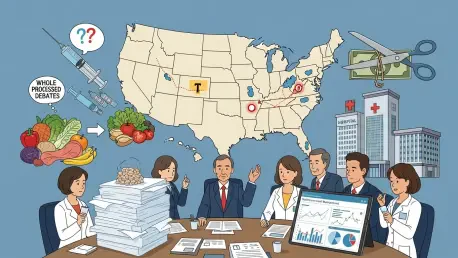

As the 2026 midterm elections approach, the political landscape is being reshaped by the “Make America Healthy Again” (MAHA) movement. At the center of this storm is the Department of Health and Human Services, where traditional public health strategies are being dismantled in favor of a radical new vision. This transformation has sparked intense debate across Capitol Hill, pitting administrative efficiency against long-standing medical norms. To understand the mechanics behind these shifts, we sat down with Donald Gainsborough, a seasoned policy architect at the forefront of legislative affairs, to discuss the administration’s aggressive budget cuts, the overhaul of national dietary standards, and the controversial recalibration of vaccine and pesticide policies.
The following discussion explores the strategic rationale behind a 12 percent reduction in federal health spending, the complexities of renegotiating with the massive American food industry, and the administration’s controversial stance on agricultural chemicals and childhood immunizations. We also delve into the practicalities of a direct-to-citizen insurance model and the long-term implications of reducing research funding at the National Institutes of Health.
The administration has proposed a 12 percent cut to federal health agencies to eliminate programs deemed inefficient. How do you identify which specific initiatives are “bloated,” and what metrics will you use to ensure these cuts don’t compromise essential public health services?
Identifying inefficiency requires a cold, hard look at whether a program actually produces measurable health improvements or simply feeds a self-perpetuating bureaucracy. We are targeting programs that we categorize as “woke” or redundant—those that have drifted away from the core mission of basic health protection and into social engineering. For instance, within the CDC, we have found several award cycles that have stalled or failed to yield actionable data, suggesting that the funds are not being utilized effectively. We monitor success by looking at the “bottom line” of American health: are chronic disease rates, obesity levels, and cancer incidences actually moving downward? If a program has seen its budget grow while the national health outcomes it oversees continue to decline, that is our primary metric for “bloated” and a clear signal for elimination.
Efforts are underway to shift national dietary guidelines toward nutrient-dense whole foods while phasing out artificial dyes. What specific hurdles do you face when negotiating with the food industry, and what step-by-step process is required to overhaul these long-standing safety standards for food additives?
The primary hurdle is the sheer inertia of an industry that has relied on “generally recognized as safe” (GRAS) designations to bypass rigorous oversight for decades. Our process begins with a systematic review of these additives, many of which haven’t been scrutinized under modern toxicological standards in years. We are currently moving through a phase of active negotiation to voluntarily remove artificial dyes, which is the first step before we pivot toward more stringent regulatory enforcement. This is a delicate dance; we are asking multi-billion dollar corporations to fundamentally change their recipes to favor real, whole foods over processed fillers. We believe that by changing the national dietary guidelines first, we create a market demand that forces the industry to adapt or lose its government-sanctioned “healthy” stamps.
Recent executive orders have prioritized increasing glyphosate production to support the agricultural sector despite various health concerns. How do you balance the economic needs of farmers with public health safety, and what evidence-based criteria are guiding your internal policy discussions on pesticide use?
This is undoubtedly one of our most complex balancing acts, particularly given that a World Health Organization agency has identified evidence linking glyphosate to cancer. However, the February executive order was driven by the immediate economic necessity of maintaining U.S. agricultural yields, as glyphosate remains a cornerstone of current farming infrastructure. Internally, we are weighing this economic output against the long-term costs of the chronic disease epidemic we are seeing across the country. Our criteria focus on finding a transition point where we can support farmers without permanently compromising the “MAHA” goals. It is a source of internal tension, but we are looking for ways to maximize agricultural productivity while simultaneously investigating safer alternatives that don’t carry the same carcinogenic risks.
There is significant debate surrounding the decision to reduce the number of government-recommended childhood vaccines. What data points are driving this shift in policy, and how do you plan to address concerns from medical professionals who fear a resurgence of preventable diseases?
The policy shift is driven by a deep skepticism of the current status quo, which we believe has failed to adequately address parental concerns regarding the sheer volume of the childhood immunization schedule. We are looking at data points that suggest a correlation—though debated—between the rising number of vaccines and the explosion of chronic conditions and neurodevelopmental issues. To address the concerns of the medical community, we are emphasizing transparency and personal choice, arguing that the “status quo sucks” when you look at the overall health of American children today. Our strategy is to focus on a more streamlined recommendation list that prioritizes essential protections while paring back on those we deem less critical. We believe that by being honest about the perceived risks, we can actually rebuild trust in the public health system, even if it means clashing with traditional medical associations.
The administration is pushing for voluntary pricing deals with drug companies and a model where insurance funds are sent directly to citizens. How would this direct-payment system function on a practical level, and what prevents pharmaceutical companies from simply raising prices despite these voluntary agreements?
The direct-payment model is designed to cut out the “middleman” of insurance companies and put purchasing power back into the hands of the individuals. Practically, this involves sending federal funds directly to eligible citizens to help them purchase their own coverage or pay for services, maximizing price transparency from both providers and insurers. To keep prices in check, we are working to codify the voluntary pricing deals that have already been struck with several major drug companies. The deterrent for raising prices is the transparency itself; once patients see the true cost of their care and have the money in their own pockets, the market competition increases. We believe that when pharmaceutical companies have to compete for a citizen’s direct dollar rather than a faceless insurance payout, the incentive to inflate prices diminishes.
Proposed budget reductions for the National Institutes of Health suggest a 10 percent decrease in research funding. How will this reduction affect ongoing university health studies, and what is your strategy for maintaining American leadership in medical innovation while operating with a significantly smaller research budget?
A 10 percent cut to the NIH, following an even steeper request for the previous year, is a call for a total paradigm shift in how we fund science. We recognize this will force university health studies to become much more efficient and perhaps seek private-sector partnerships to bridge the gap. Our strategy for maintaining leadership isn’t based on how much money we throw at the problem, but on how we direct the remaining funds toward the most pressing chronic disease crises. We are moving away from broad, open-ended grants and toward targeted research that supports our “MAHA” objectives, such as nutrition and environmental health. While defenders of the NIH in Congress, like Senator Collins, may fight these cuts, we believe that a leaner budget will strip away “low-value” research and force innovation in areas that actually improve the daily lives of Americans.
Adjustments to Medicaid eligibility are expected to result in millions of individuals losing their current health coverage. What is the plan for managing the resulting strain on hospital emergency rooms, and how do you verify that those losing coverage truly fall outside the intended safety net?
Our focus is on restoring Medicaid to its original purpose: a safety net for those who truly cannot provide for themselves. We anticipate that as many as 15 million people may see changes in their coverage status, but our position is that many of these individuals were incorrectly enrolled, including those who are able to work or are in the country illegally. To verify eligibility, we are implementing much more rigorous oversight and work requirements to ensure that the safety net remains robust for the truly vulnerable. Regarding the strain on emergency rooms, we believe that by lowering overall drug costs and improving general nutrition through our other initiatives, we will eventually reduce the total number of people needing emergency care for preventable chronic issues. It is a transition period, but one we feel is necessary to ensure the long-term solvency of the program.
What is your forecast for the future of American public health under the MAHA initiative?
I forecast a period of intense disruption followed by a radical realignment of the American lifestyle. We are moving away from a “sick-care” system that profits from chronic illness and toward a model that prioritizes the purity of our food supply and the transparency of our medical costs. While the transition will be marked by political friction and legal challenges—especially regarding vaccine schedules and pesticide use—I believe we will see a marked decline in obesity and metabolic disease by the end of the decade. The success of this movement hinges on our ability to prove to the American people that the old way of doing business was designed for corporate profit, while our new way is designed for their physical survival.