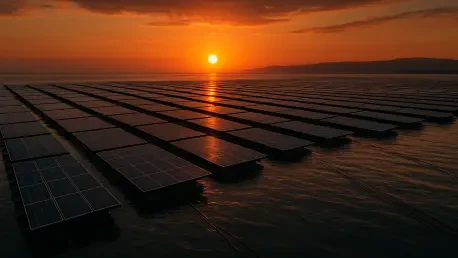

Innovative floating structures provide a lower acoustic and vibrational footprint than wind turbines, offering a more ecologically sensitive path toward national carbon reduction. In the bustling industrial landscape of 2026, Taiwan faces a profound geographic paradox that threatens its long-term sustainability goals. While the nation serves as a global hub for semiconductor manufacturing and technological innovation, its sheer population density has created a “spatial bottleneck” where every square meter of land is contested. Currently, the island relies on imported fossil fuels for over 97% of its energy needs, resulting in an annual output of approximately 262 million metric tons of carbon dioxide. With the government’s mandate to achieve net-zero emissions by 2050, the conflict between expanding renewable infrastructure and maintaining agricultural food security has reached a critical juncture. Traditional solar farms require vast expanses of terrestrial space that simply do not exist without sacrificing vital housing or farmland. Consequently, the focus has shifted toward the “blue territory” of the coast, where aquaculture and green energy must learn to coexist to survive.
The Challenge: Land Scarcity and Maritime Limitations
The primary obstacle to the green transition in this region remains the extreme competition for land-based resources. Because terrestrial space is a premium commodity reserved for housing, high-tech manufacturing, and traditional agriculture, the state cannot afford to repurpose significant portions of inland territory for power generation. This scarcity has made the development of maritime solutions a strategic necessity rather than a mere secondary option. By looking toward the ocean, planners hope to host the next generation of renewable infrastructure without encroaching on the limited land remaining for the citizenry. However, this shift is not as simple as moving land-based technology to the water. The unique environmental pressures of the Taiwan Strait, including high salinity and extreme humidity, demand a complete redesign of how solar energy is captured. As the nation attempts to balance its industrial growth with its climate obligations, the successful integration of energy production into the existing maritime economy has become the most viable path for long-term stability.
While offshore wind energy was initially touted as the definitive answer to the land crisis, it has introduced a complex set of ecological and social challenges that were not fully anticipated. The massive turbines required for wind generation produce significant underwater noise and mechanical vibrations, which can disrupt the delicate sensory systems of marine life. These disturbances are particularly problematic for the biological health of local fisheries, where sensitive species like groupers and sea bass are raised in coastal cages. Furthermore, the immense physical footprint and exclusion zones of large-scale wind farms frequently overlap with traditional fishing grounds, leading to territorial disputes and the potential displacement of local fishers from their livelihoods. This friction has created an urgent demand for a less invasive alternative that can generate clean power without interfering with the established maritime industries. Floating solar systems emerge as a promising solution, offering a smaller footprint and a more harmonious relationship with the surrounding aquatic ecosystem and stakeholders.
Engineering and Scaling: Building National Energy Resilience
To resolve these industrial conflicts, engineers have pioneered a sophisticated floating solar-storage hybrid system that recently underwent validation in the Penghu archipelago. Unlike static panels, these “smart” machines utilize a high-precision dual-axis solar tracking mechanism to follow the sun’s trajectory, significantly boosting energy absorption in volatile coastal environments. To withstand the corrosive, salty conditions of the Taiwan Strait, the units are outfitted with automated spray-cooling systems that prevent salt crystallization and maintain optimal photovoltaic temperatures. Energy reliability is further bolstered by a hybrid storage architecture combining lithium-ion and lead-acid batteries, ensuring a steady power supply even during the night. Field trials in the archipelago demonstrated that the system is remarkably efficient, producing 25.17% more energy on sunny days and over 40% more during severe weather compared to fixed systems. This localized power ensures that critical aquaculture equipment, such as oxygenation pumps and automated feeders, remains operational during grid failures or extreme monsoons.
The successful integration of floating solar modules offered a transformative economic model for the aquaculture industry, effectively turning fish cages into dual-purpose assets. By adopting this technology, fish farmers were able to “double crop” their maritime territory, generating a secondary stream of income while continuing their primary seafood harvests. Because these floating structures maintained a minimal acoustic footprint compared to wind turbines, they protected the biological health of the stock and reduced stress-induced mortality in sensitive species. For this innovative “middle path” to reach its full potential, the focus shifted toward streamlining the maritime permitting process to encourage commercial adoption. By localizing power generation at the point of consumption, the state successfully built a decentralized and resilient energy grid. This transition proved that geographic constraints could be overcome through smart engineering, providing a scalable blueprint for other coastal regions to balance economic growth with environmental sustainability.