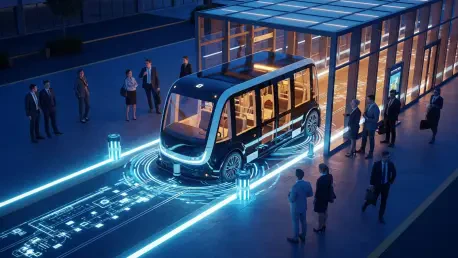

The quiet hum of an electric shuttle navigating a bustling metropolitan intersection without a steering wheel or a human operator has transitioned from a niche experimental concept to a daily reality for many commuters. As urban populations continue to expand rapidly, the traditional models of bus and rail transit face mounting pressures to increase frequency, reduce carbon footprints, and maintain cost-effectiveness. Autonomous technology offers a potential resolution to these systemic challenges by promising a high degree of precision and efficiency that human-operated systems often struggle to achieve consistently. While the initial excitement focused heavily on the novelty of hands-free driving, the current conversation has pivoted toward the fundamental restructuring of city transit networks. Integrating Level 4 and Level 5 automation requires a departure from isolated testing toward a cohesive ecosystem where vehicles communicate with traffic signals. This transformation is not merely about replacing drivers with software; it represents a comprehensive shift in how cities move people and manage resources.
Technical Infrastructure: Connectivity and Reliability
Part 1: The V2X Communication Network
The successful implementation of autonomous public transit depends entirely on a robust communication layer known as Vehicle-to-Everything (V2X) connectivity. This technology enables buses and shuttles to receive instant updates from municipal traffic management centers regarding congestion, road hazards, or emergency vehicle priority. In cities like Phoenix and Singapore, the deployment of dedicated short-range communications (DSRC) and 5G cellular networks has created a digital canopy that supports sub-millisecond latency for critical decision-making processes. Unlike early prototypes that relied solely on onboard sensors, modern autonomous fleets leverage external infrastructure to see around corners and anticipate pedestrian movements beyond the vehicle’s line of sight. This networked approach significantly reduces the likelihood of accidents caused by sensor occlusion or unexpected environmental variables. Furthermore, the integration with smart power grids allows electric autonomous fleets to optimize charging schedules based on demand.
Part 2: Virtual Platooning and Fleet Synchronization
Building on this connectivity, the synchronization of fleet movements allows for the creation of virtual platoons, where multiple autonomous units travel in close proximity to reduce aerodynamic drag and optimize road space. This behavior mimics the efficiency of a train but maintains the flexibility of individual buses that can decouple to serve different suburban branches. Data collected from these interactions is fed back into centralized AI models that continuously refine routing algorithms, ensuring that the entire transit network adapts to real-time shifts in passenger volume. Local governments have begun to mandate open data standards, allowing different manufacturers of autonomous vehicles to share infrastructure seamlessly. This interoperability prevents the formation of technological silos and ensures that the public transit network remains a unified service. By prioritizing low-latency communication over raw speed, engineers have established a foundation for a reliable and predictable urban transport system.
Economic and Social Evolution: Shaping the Future
Part 3: Workforce Integration and Strategy
The transition toward driverless systems inevitably raises significant questions regarding the future of the transit workforce and the overall economic sustainability of public agencies. Traditionally, labor accounts for a substantial portion of the operating budget for municipal bus services, often limiting the ability of cities to provide late-night or low-traffic route coverage. By removing the direct labor cost associated with every vehicle hour, cities can feasibly deploy smaller, more frequent shuttles that operate on demand rather than on a rigid schedule. However, this shift does not necessarily mean the total elimination of transit jobs but rather a transformation of existing roles. Maintenance technicians, remote fleet monitors, and on-board ambassadors are becoming essential positions that require higher technical skills and specialized training. Organizations that have proactively invested in retraining programs for their human drivers found that the move to automation created new career paths in software management.
Part 4: Accessibility and Equitable Distribution
In the final assessment, the true measure of autonomous transit success was found in its ability to serve populations that were historically marginalized by traditional transportation designs. Automated micro-mobility solutions successfully bridged the first-mile and last-mile gaps for residents in suburban areas where large buses were impractical to operate. Cities that prioritized wheelchair-accessible autonomous pods and voice-activated navigation interfaces provided a level of independence for elderly and disabled commuters that was previously unattainable. These systems also addressed the safety concerns of nighttime travelers by offering predictable, well-monitored environments through constant video surveillance and direct links to emergency dispatchers. Moving forward, the focus shifted from technical feasibility to equitable distribution, ensuring that lower-income neighborhoods received the same technological upgrades. Decision-makers recognized that the driverless model worked best when it was treated as a public utility rather than a luxury service.