
As a veteran architect of legislative strategy and the leading voice at Government Curated, Donald Gainsborough has spent decades navigating the labyrinthine corridors of power in both Albany and City Hall. His expertise lies at the intersection of fiscal reality and progressive policy, making him a central figure in the evolving debate over how New Yorkers move through their city. With the transit landscape shifting under the weight of budget negotiations and shifting political alliances, Gainsborough provides an insider’s perspective on the ambitious push to make the city’s bus system both “fast and free.” This conversation explores the collision between high-minded affordability goals and the granular friction of state-level politics, focusing on the future of pilot programs, the rivalry between universal and means-tested aid, and the delicate balance of upstate-downstate interests.
Previous efforts to pilot free bus routes across the five boroughs faced significant setbacks during budget negotiations. What specific metrics from those initial tests justify a second attempt in 2026, and how can leaders navigate the internal legislative disputes that previously stalled these expansions?
The 2023 pilot program was a landmark moment because it proved that one free route in each of the five boroughs could fundamentally change how residents engage with the transit system. Advocates are looking at the success of that initial rollout as the bedrock for the 2026 proposal, arguing that the social utility of removing fare friction outweighs the immediate loss in revenue. However, the political reality is that internal disputes, specifically between high-ranking Assembly leadership and vocal proponents, turned a successful operational test into a legislative casualty in 2024. To navigate this in 2026, leaders must move beyond the rhetoric of housing deals and budget trade-offs that poisoned the well last time. There is a palpable sense of urgency now, with the mayor explicitly committed to making buses “fast and free,” but success requires translating that enthusiasm into firm language and specific dollar figures within the state budget.
Some officials prefer expanding means-tested programs like Fair Fares, while others argue these systems fail to reach everyone eligible. How do the operational costs of a universal free bus system compare to income-based discounts, and what are the societal trade-offs of each approach?
The debate between universal access and means-testing is where the ideological rubber meets the road. Currently, the Fair Fares program costs roughly $96 million a year to provide half-price transit to about 400,000 low-income New Yorkers, yet many argue this barely scratches the surface of the actual need. Projections suggest that expanding this program to offer fully free fares and wider eligibility could add another $150 million to the bill, and that is assuming only half of those eligible actually sign up for the benefit. Universalists point to the “universal daycare” model as proof that income-based programs often leave the most vulnerable behind due to bureaucratic hurdles and the stigma of registration. While means-testing feels fiscally responsible to some, the “habitual aversion” to these programs stems from the fact that they rarely achieve 100% penetration, leaving a gap that only a truly free system can fill.
Legislative leaders have raised concerns that citywide free transit is financially unfeasible without addressing upstate transportation needs. What specific funding mechanisms could bridge this gap, and how can the city balance a commitment to free service with the transit authority’s existing budgetary constraints?
The “upstate-downstate” divide is a perennial hurdle in Albany, and Senator Jeremy Cooney has been very clear that making every bus in the city free is a hard sell without parity for other regions. To bridge this gap, we have to look at funding mechanisms that treat transit as a statewide infrastructure priority rather than a local New York City perk. This might mean tying city transit subsidies to increased funding for upstate transportation systems, ensuring that a win for a commuter in Brooklyn is also a win for one in Rochester. The transit authority is already under immense pressure, and leadership like Janno Lieber is rightfully wary of “studying things” that aren’t on the official agenda of the state’s power players. The city must prove it can fund its half of the bargain without draining the MTA’s existing coffers, potentially through a hybrid of state grants and municipal contributions.
Efforts to make buses free often compete with the technical requirements of making them faster and more reliable. How should the city prioritize investments between fare elimination and infrastructure like dedicated bus lanes, and what immediate impacts would these changes have on the daily commute?
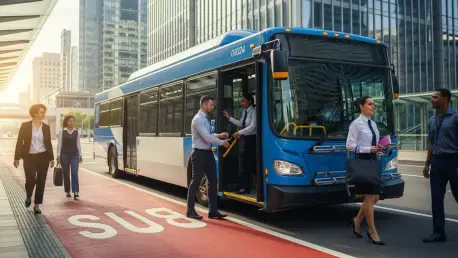
There is a visceral frustration in standing on a street corner watching three buses crawl through traffic, and that is why the “fast” part of the “fast and free” mantra is so critical. If a bus is free but remains stuck in a gridlock of delivery trucks and double-parked cars, the policy has failed the rider who is trying to get to a shift on time. The MTA and the city are currently collaborating on speed improvements, but there is a constant tug-of-war for capital; do we spend a million dollars on fare enforcement and collection, or do we spend it on painting dedicated lanes and installing signal priority tech? The immediate impact of prioritizing infrastructure is a more predictable life for the commuter, where a 40-minute trip consistently takes 20 minutes. Fare elimination provides the emotional and financial relief, but infrastructure provides the dignity of time, and balancing the two is the greatest challenge facing the current administration.
With major global events and budget hearings looming, free transit proposals often get sidelined for more immediate fiscal concerns. What steps are necessary to keep transit affordability on the legislative agenda, and how can advocates ensure that pilot programs eventually transition into permanent, citywide policy?
Maintaining momentum requires keeping the conversation focused on the lived experience of New Yorkers rather than just the abstract numbers on a ledger. When major events like the World Cup come to town, the conversation often shifts to how we accommodate tourists paying $1,000 for a ticket, rather than how we help the worker who has to commute to the stadium. Advocates like the Riders Alliance are essential because they ensure that transit affordability remains a top-tier political issue even when the news cycle moves toward housing or public safety. Transitioning from a pilot to permanent policy requires a “first step” mentality—lawmakers in Albany seem more open to a phased 2026 rollout than a total overnight overhaul. We need to see firm dollar figures and binding language in the Senate and Assembly budgets to move this from a campaign talking point to a permanent fixture of New York life.
What is your forecast for the future of transit affordability in New York?
I anticipate a significant move toward a hybrid model by 2026, where we see an aggressive expansion of the Fair Fares program alongside a new, more robust set of free pilot routes. We likely won’t see a 100% free citywide bus system in the next twenty-four months, but the political pressure is reaching a boiling point that Albany can no longer ignore. Expect to see the $150 million expansion of means-tested aid become the primary vehicle for affordability in the short term, while the mayor and his allies use the 2026 pilot to build the data-driven case for a broader roll-out. The goal will be to make the transit system feel like a public utility—as essential and accessible as the sidewalks we walk on—even if the path to getting there is paved with incremental legislative victories.